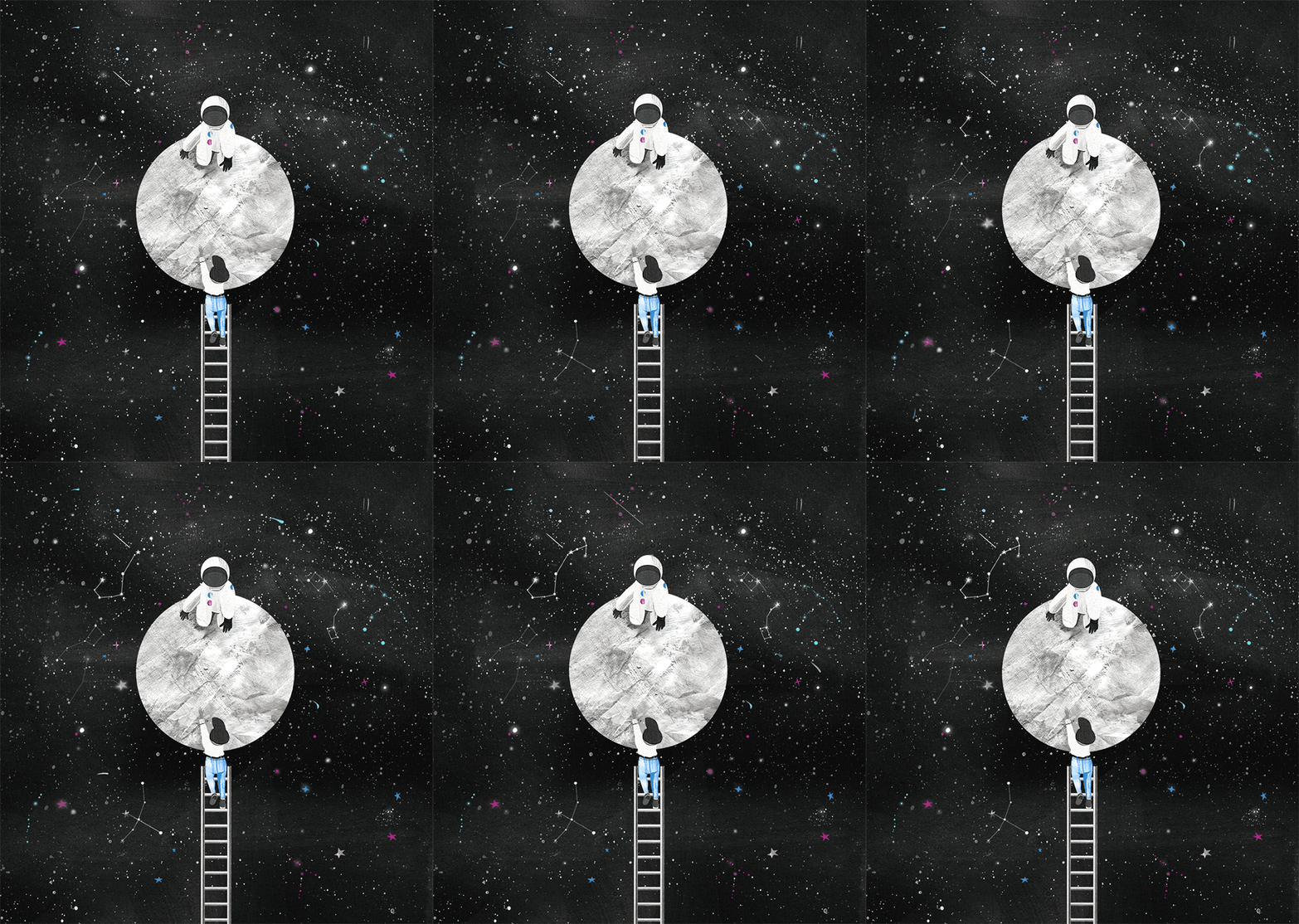
Why a circular lunar ecosystem could be the solution. $$PLAIN_TEXT_PREVIEW$$

Hello!

Welcome to the first edition of The Transmission! A six-part newsletter series presented by Moon Dialogs featuring content on our three themes: Sustainable Moon, Accessible Moon, and Peaceful Moon.

This inaugural newsletter is focused on Sustainable Moon. 🌔🌿

As we continue to grow our presence on the Moon, key questions are arising regarding how our activity will impact the lunar surface (and vice versa). To dig a bit deeper, we posed the question, “If resources on the Moon are scarce, how can we ensure long-term human presence is sustainable?” to Antonino Salmeri, a doctoral researcher in space law and lead of the E.A.G.L.E. Action Team on Lunar Governance. Below, we share an excerpt of his response along with a few from our audience. To read Antonino’s full answer, click here.

Enjoy, and please share!

➤ The Big Question

If resources on the Moon are scarce, how can we ensure long-term human presence is sustainable?

Written by Antonino Salmeri

At first glance, talking about the scarcity of resources within the endless vastness of space may seem paradoxical. Yet, this is the situation we face on the Moon. Our only natural satellite is, unfortunately, unable to renew its resources, which means that everything on the Moon comes, by definition, in limited quantities (unless refilled by external forces). This inherent scarcity of lunar resources naturally brings to mind the question of how to manage them.

“Lunar resource management should first and foremost aim for sustainability as a means to achieve inclusiveness.”

I argue that in light of the scientific, cultural, and spiritual importance of the Moon for all of humanity, lunar resource management should first and foremost aim for sustainability as a means to achieve inclusiveness. The Moon has always been there for us, and it should continue to welcome all humans across time and space. From an intergenerational viewpoint, preserving the continued accessibility of the Moon is not a choice, it is a necessity. In this perspective, being mindful of the special significance of the Moon is the first and most important step towards the sustainable establishment of a long-term presence. Only if we accept the limitations imposed by the scarcity of lunar resources and the hostility of its environment, can we turn these apparent obstacles into opportunities.

“The (current) lunar desolation offers us a unique opportunity to develop a virtuous circular ecosystem for managing its resources.”

The law of conservation of mass tells us that nothing is lost and nothing is created [because] everything is transformed. In accordance with this essential universal principle, the natural solution to the problem of scarcity is circularity. In a circular system, the value of each resource is maximized by connecting its individual processing with secondary actions that can benefit from it. On Earth, circular processes like the lithogenic, atmospheric and biogenic cycles have successfully renewed the resources of the planet for billions of years (until humans began disrupting these cycles, of course). The Moon has no such cycles of its own, but we can fill this gap by conducting activities as part of a circular ecosystem. When Buzz Aldrin became the second human to visit the lunar surface, he described it as a “magnificent desolation.” Well, the (current) lunar desolation offers us a unique opportunity to develop a virtuous circular ecosystem for managing its resources.

Further, lunar circularity would also increase our efficiency, since it would allow us to avoid duplications, as well as distribute costs and create new market opportunities. Finally, achieving circularity on the Moon would also be beneficial for the sustainable development of the Earth—it would provide us with technologies and processes for resource management in extreme environments.

 âž¤ Read Antonino’s full piece! 

➤ The Comet Section

We posed “The Big Question” to our audience. Here’s what they had to say.

****

“Collaboration, precaution, and a sustainable development paradigm. Comprehensive knowledge about all lunar resources, all planned activities, all interactions between operations, and the evaluation of all that is impossible. We need to actively consider sustainable lunar development, act with precaution, and enable transparency, trust, and collaboration.” — Lukas, Germany

****

“We can utilize resources on the Moon to establish a sustainable, permanent presence. The Moon's regolith has elements that can be used to provide radiation protection and for manufacturing activities—this will increase sustainability because we won't have to bring materials from Earth. In addition, farming is an activity that can help make the Moon sustainable. With new advances in farming (like hydro/aeroponic farms), we could increase food production. These might seem like simple ideas but food, water, and shelter are necessary to establish sustainable lunar settlements.” — Nitya, India

****

“Sustainability will come through transparency. Long term presence on the Moon will only be possible if [everyone] involved ensures that the technology, information and data are available, enabling citizens all around the globe to watch and ensure the benefits of lunar exploration are for all humankind...” — Pablo, Germany

****

“…We need a resource-sharing model routed in open governance and built on a technological framework. A lunar registry mapping various conventional (e.g. mineral resources, volatile and ice deposits) and non-conventional resources (e.g. radio quiet zones, peaks of eternal light) maintained on decentralized distributed ledger technology or blockchain might be an interesting model to explore.” — Mariam, Canada

****

“How we define sustainability matters. We must decolonize Moon exploration and reframe our understanding of what it means to have a sustainable human "presence" on the Moon. By shifting our focus away from resource extraction to one centred on our relationship with and understanding of the moon we can more effectively advance sustainable, just, and equitable lunar governance, policy, science, and culture.” — Bushra, Canada

****

➤ Add to Your Tabs

Interested in learning more about lunar sustainability? Here are some resources put together by the Sustainable Moon 🌔🌿 Action Team:

  • Waste Management for Lunar Resources Activities: Towards a Circular Lunar Economy (2020) by Paolo Pino, Antonino Salmeri, Adam Hugo and Shayna Humes

  • Polycentricity for Governance of the Moon as a Commons (June 2021) by Lukas Kuhn

  • Concentrated Lunar Resources: Imminent Implications for Governance and Justice (February 2021) by Martin Elvis, Alanna Krolikowski, and Tony Milligan

  • How much of the Solar System should we leave as Wilderness? (May 2019) by Martin Elvis and Tony Milligan

  • The development of natural resources in outer space (July 2018) by Scot W Anderson, Korey Christensen and Julia LaManna

  • Sustainable Challenges on the Moon (October 2017) by Lukas Weiss, Christian Stenzel, and Thomas Rohr

➤ What’s for Launch?

We’re taking a break from our monthly salons in August, so catch up on what you’ve missed here, including our last salon on lunar safety zones!

đź‘‹ Catch you Lunar!

We hope you enjoyed this first edition of The Transmission! Our next edition will be published in late August and will focus on Peaceful Moon 🌔🕊.

We’ll release “The Big Question” for our 2nd edition and begin accepting submissions on Monday, August 9.

Stay tuned by following us on Twitter or checking our website!


About Moon Dialogs

The Moon Dialogs is a partnership focused on governance and coordination mechanisms for the lunar surface. Visit moondialogs.org to get involved. The Transmission is prepared and edited by Victoria Heath, Program Manager at Moon Dialogs with help from the Conveners.

Feature image credit: Nancy Liang (CC BY-NC-ND)

Disclaimer: The views and opinions expressed in this newsletter do not necessarily reflect the views and opinions of Moon Dialogs or its stakeholders, conveners, and partners. Questions or concerns can be directed to victoria@moondialogs.org.

Moon Dialogs
340 S Lemon Ave #1606
Walnut, CA 91789
United States

Unsubscribe